Cuba
The flag of Cuba
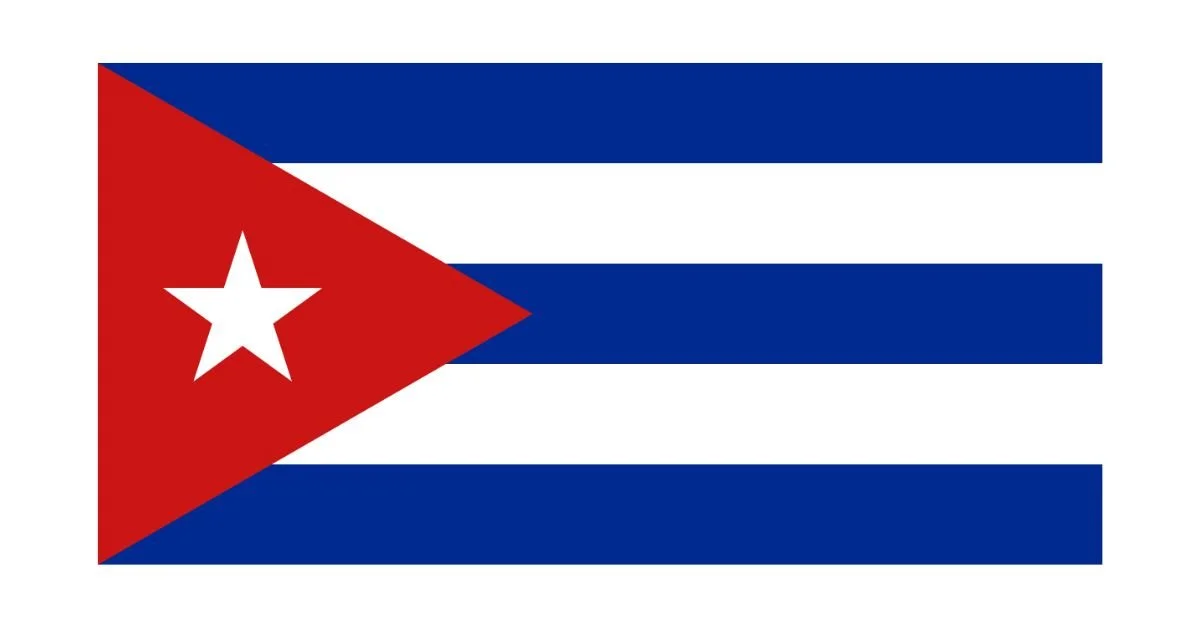
The flag of Cuba is a powerful emblem of national identity, revolutionary heritage, and the enduring struggle for independence. Known in Spanish as la Estrella Solitaria ("the Lone Star"), the Cuban flag features five alternating horizontal stripes of blue and white, a red equilateral triangle on the hoist side, and a single white five-pointed star centered within the triangle. This striking design has remained unchanged since its creation in the mid-19th century and was officially adopted as the national flag on May 20, 1902, when Cuba gained formal independence from the United States.
The origins of the Cuban flag are closely tied to the fight for liberation from Spanish colonial rule. The flag was designed in 1849 by the Venezuelan general Narciso López, a strong advocate for Cuban independence, in collaboration with the Cuban poet Miguel Teurbe Tolón. Inspired by the flag of the United States, which López admired for its symbolism of freedom and democracy, the Cuban flag incorporates similar visual elements but adapts them to reflect Cuba’s own revolutionary aspirations and national character.
The five horizontal stripes—three blue and two white—represent Cuba's original political divisions. At the time, the island was divided into three major regions: Occidental (West), Central, and Oriental (East). The blue stripes stand for these three regions, while the two white stripes symbolize the purity of the Cuban people's ideals and their unity in pursuit of freedom.
The red triangle on the hoist side carries deep symbolic meaning. The equilateral shape represents equality and strength, while the color red signifies the blood shed by those who fought and died for Cuba’s independence. The triangle also echoes Masonic symbolism, which was influential among many 19th-century revolutionaries in Latin America.
At the center of the red triangle is a white five-pointed star, the Estrella Solitaria, or "Lone Star." The star represents the guiding light of liberty and independence, as well as the hope that Cuba would one day join the family of free nations. Although early supporters like López hoped for U.S. annexation, the star eventually came to symbolize Cuba’s own sovereign destiny.
Throughout Cuba’s turbulent history—from colonial oppression and wars of independence, to U.S. occupation, to the 1959 Cuban Revolution—the flag has endured as a constant symbol of resistance, national pride, and ideological conviction. During the revolution led by Fidel Castro and the 26th of July Movement, the Cuban flag was joined by other revolutionary symbols, but it remained central to the national identity. Unlike many other Latin American nations, Cuba retained its original flag through its major political transformation, which reflects the deep historical continuity and emotional resonance the flag holds for Cubans.
Recently Posted

Categories
- Alberta 26
- Armed Forces 38
- British Columbia 22
- Canada 311
- Cities 151
- County / Municipality / Regional District / Township 6
- Government 18
- Historical 4
- Indigenous 39
- International Flags 56
- International Organizations 5
- Manitoba 17
- Miscellaneous 4
- New Brunswick 8
- Newfoundland 12
- Northwest Territories 7
- Nova Scotia 14
- Nunavut 6
- Ontario 40
- Police 1
- Prince Edward Island 5
- Quebec 70
- Royalty 15
- Saskatchewan 14
- Schools 12
- Sports 25
- Yukon 4