On October 5, 1984, the red-and-white Maple Leaf slipped the bonds of Earth to enter low Earth orbit for the very first time. Affixed to the flight suit of Marc Garneau aboard the Space Shuttle Challenger, the national flag of Canada was no longer merely a terrestrial symbol. It had become a cosmic emblem. While the creation of Canada's flag in 1965 was forged in a crucible of fierce parliamentary debate, its subsequent deployment into space transformed it into a global and extra-planetary symbol of technological excellence, diplomatic cooperation, and scientific ambition. From the iconic arm bands of the Canadian astronaut corps to its permanent, structural integration on the historic Canadarm systems, the flag in space has served a dual purpose. It asserts sovereign identity in a frontier historically dominated by superpowers, while simultaneously projecting Canada’s core values of peaceful collaboration and multilateral discovery.

Marc Garneau - The first Canadian in space.
To fully appreciate the significance of the Canadian flag’s journey into the cosmos, one must examine the country’s early entry into the space age. Canada was not a latecomer to space exploration. On September 29, 1962, with the launch of the Alouette 1 satellite, Canada became the third nation in the world—after the Soviet Union and the United States—to design and construct its own artificial satellite. However, in 1962, Canada still lacked its own distinctive national flag. Alouette 1 was launched using the Canadian Red Ensign as the country's de facto emblem. When the modern Maple Leaf flag was officially inaugurated on February 15, 1965, Canada's space program was undergoing a profound structural evolution. The focus was shifting from upper-atmospheric research to active infrastructure development and satellite communications, highlighted by the Anik satellite launches of the early 1970s.
The true symbolic turning point occurred when human spaceflight entered the Canadian portfolio. In 1983, the National Research Council of Canada established the first Canadian Astronaut Program, selecting six pioneers: Marc Garneau, Roberta Bondar, Steve MacLean, Ken Money, Robert Thirsk, and Bjarni Tryggvason. When Marc Garneau made history during the STS-41-G mission in 1984, the physical placement of the Canadian flag on his NASA-issued flight suit was an act of profound national significance. For a country historically caught between the cultural and political spheres of Great Britain and the United States, seeing the clean, minimalist lines of the Maple Leaf operating alongside the American Stars and Stripes on the world's most sophisticated aerospace platform signaled that Canada had arrived as a first-tier spacefaring nation.
While individual astronauts carried the flag on their apparel, the most enduring visual legacy of the Canadian flag in space belongs to the Shuttle Remote Manipulator System, universally known as the Canadarm. Developed by Spar Aerospace and delivered to NASA as Canada’s industrial contribution to the Space Shuttle program, the Canadarm debuted in 1981 aboard the Space Shuttle Columbia. The Canadarm was a masterclass in engineering, but it was also a masterclass in geopolitical branding. Prominently emblazoned on the arm's white thermal insulation blankets was the word "Canada," accompanied by the stylized red Maple Leaf flag. This was not a minor aesthetic choice; it was a negotiated right of industrial contribution. Because space exploration was broadcast globally via television, the Canadarm became a constant visual fixture of NASA missions. Every time the shuttle cargo bay opened to deploy a satellite, repair the Hubble Space Telescope, or capture a wandering payload, global audiences witnessed the Canadian flag operating at the literal edge of human capability.

Canadarm was first launched into space on November 12, 1981 aboard the Space Shuttle Columbia.
The success of the original Canadarm solidified Canada’s reputation as the world leader in space robotics. This reputation was deepened with the development of the Space Station Remote Manipulator System (Canadarm2) and the Special Purpose Dexterous Manipulator, known as Dextre, which were installed on the International Space Station (ISS) in the early 2000s. On the ISS, the Canadian flag on Canadarm2 took on an even greater geopolitical resonance. The space station is a collaborative, international laboratory governed by complex legal frameworks. The presence of the Canadian flag permanently attached to the exterior of the station serves as a structural marker of sovereign territory and critical infrastructure, reminding all partner nations—and the public below—that the entire multi-billion-dollar facility relies daily on Canadian technological innovation to survive and operate.
As the Canadian astronaut corps expanded, the physical flag accompanied these explorers through a series of profound national firsts, with each mission using the flag to communicate specific cultural messages back to Earth. In January 1992, Roberta Bondar became Canada’s first female astronaut and the first neurologist in space aboard the Space Shuttle Discovery. Bondar brought a unique perspective to the symbolism of the flag, viewing her mission through a lens of environmental stewardship and scientific inclusivity. The flag on her suit represented the capability of Canadian women in STEM fields, breaking a long-standing glass ceiling in national aerospace history.

Canadian Astronaut Chris Hadfield in the Cupola of the International Space Station
Chris Hadfield’s spaceflight career fundamentally transformed how Canadians interacted with their flag in space. During his 2001 mission, Hadfield became the first Canadian to perform a spacewalk. For the first time, the Canadian flag patch was exposed directly to the harsh vacuum of open space, affixed to the shoulder of his Extravehicular Mobility Unit. Later, during his tenure as Commander of Expedition 35 in 2013, Hadfield used digital social media to democratize the space experience. His photos of the Earth, frequently framed with the Canadian flag patch visible in the window of the ISS Cupola, connected millions of citizens to the cosmic frontier. When Hadfield performed a zero-gravity rendition of David Bowie’s "Space Oddity," wearing a shirt emblazoned with the Canadian astronaut patch, he merged national iconography with global popular culture, solidifying the Maple Leaf as a modern symbol of accessible, humanistic science.
Robert Thirsk’s Expedition 21 mission in 2009 marked Canada’s first long-duration stay aboard the ISS, lasting 188 days. This was followed a decade later by David Saint-Jacques during Expedition 58/59. On these extended missions, the Canadian flag ceased to be a temporary visitor to orbit; it became a permanent resident. The flag patch on their daily wear clothes became a symbol of Canada's sustained, operational presence in space, demonstrating that Canadian scientists were living and working in microgravity over cycles of half a year or more.
The presence of a national flag in space requires significant material science and logistical engineering. The space environment is exceptionally hostile, characterized by extreme thermal cycling ranging from minus one hundred and twenty degrees to plus one hundred and twenty degrees Celsius, intense ultraviolet radiation, atomic oxygen degradation, and the constant threat of micrometeoroid impacts. Atomic oxygen corrodes standard organic polymers and bleaches pigments, which requires the utilization of advanced fluoropolymers on external surfaces. Thermal cycling causes rapid expansion and contraction that can crack standard plastics, requiring advanced Nomex and Kevlar thread weave matrices for any stitched elements. Unshielded ultraviolet radiation rapidly discolors and breaks down traditional nylon or polyester fabrics, forcing the development of high-stability synthetic fibers coated with UV-resistant shields.

Canadian Space Agency astronaut David Saint-Jacques takes a selfie during a 2019 spacewalk outside the International Space Station. Credit- Canadian Space Agency/NASA
For flags worn inside the spacecraft or station, standard fire-retardant synthetic textiles like Nomex are used to comply with NASA’s strict flight safety and flammability regulations. However, for flags placed on the exterior of the spacecraft—such as those on the Canadarm2 or the hulls of modules—the manufacturing processes are drastically different. External flags are typically not made of woven cloth. Instead, they are meticulously painted or chemically etched onto structural surfaces using highly specialized, space-qualified coatings, or fabricated from thermal insulation materials such as Kapton or Beta cloth. The red and white pigments must be specifically formulated to resist environmental bleaching, ensuring that the vibrant red of the maple leaf does not turn to a ghostly white under the unshielded glare of the sun.
Furthermore, the physical flags carried by astronauts as personal effects or official presentation items are subject to strict weight, volume, and manifestation rules. Every gram launched into orbit requires significant fuel energy. The Canadian Space Agency meticulously logs and certifies every flag that flies, providing them with official flight certificates upon return. These flown flags are then distributed to schools, hospitals, and municipal buildings across Canada, serving as high-value motivational and educational tools that connect local communities to cosmic achievements.
As human spaceflight transitions from low Earth orbit back toward deep space and lunar exploration, the role of the Canadian flag is evolving from a marker of orbital partnership to a symbol of deep-space sovereignty. Under the framework of the Artemis Accords—a multilateral agreement led by the United States to return humans to the Moon—Canada secured a historic position. In exchange for providing Canadarm3, an advanced artificial-intelligence-driven robotic system for the lunar-orbiting Gateway station, Canada earned astronaut slots on upcoming lunar missions.
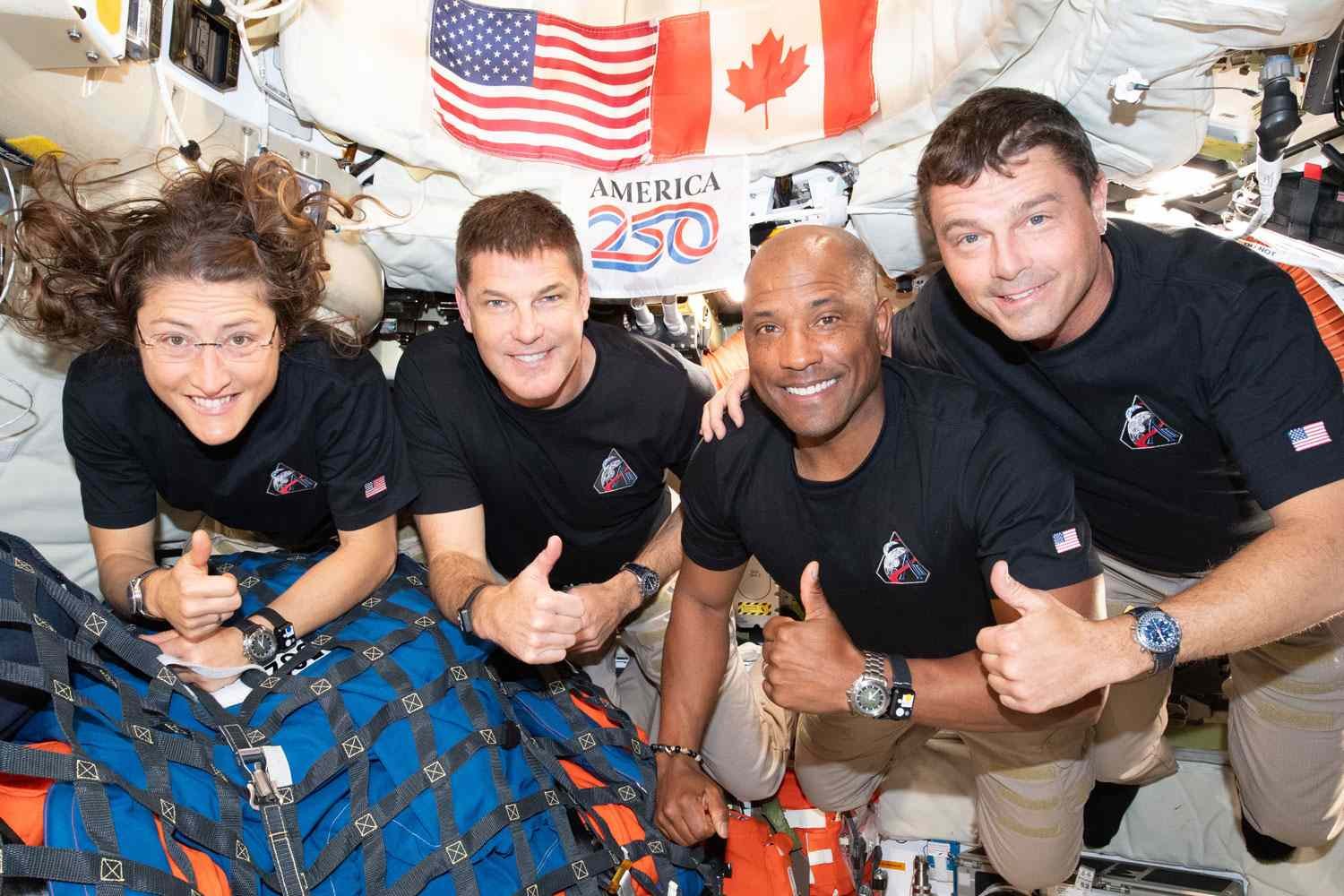
Artemis II crew, including Canadian Astronaut Jeremy Hanson, in space (April 2026)
The assignment of Canadian Space Agency astronaut Jeremy Hansen to the Artemis II mission represents a monumental step for the national symbol. When Artemis II loops around the far side of the Moon, Hansen will carry the Canadian flag farther into deep space than any human from a non-superpower nation has ever traveled. In this deep-space context, the flag takes on an entirely new meaning. It is no longer just about demonstrating competence to allies or asserting identity on a television broadcast. The Canadian flag on the Moon and the Lunar Gateway symbolizes Canada's active participation in the commercialization, governance, and exploration of the next frontier of human civilization. It ensures that Canadian legal frameworks, ethical values, and industrial capabilities are baked into the founding architecture of permanent off-world settlements.
The journey of the Canadian flag into space reflects the broader trajectory of the nation itself. What began in 1965 as a brand-new, terrestrial compromise to solve an internal identity crisis has evolved into an interstellar beacon of scientific progress and peaceful collaboration. When the Maple Leaf is seen floating inside the International Space Station, etched into the carbon-fiber limbs of the Canadarm, or stitched onto the shoulder of an astronaut bound for lunar orbit, it transcends traditional notions of flag-waving nationalism. Instead, the Canadian flag in space stands as a testament to what a medium-sized nation can achieve when it matches specialized technical brilliance with a steadfast commitment to working alongside global partners for the advancement of all humanity. As humanity looks toward Mars and beyond, the red-and-white leaf will undoubtedly continue to serve as Canada's permanent signature among the stars.
Recently Posted


Categories
- Alberta 29
- Armed Forces 41
- British Columbia 27
- Canada 343
- Cities 163
- County / Municipality / Regional District / Township 8
- General Information 2
- General information 1
- Government 18
- Historical 4
- Indigenous 45
- International Flags 60
- International Organizations 5
- Manitoba 19
- Miscellaneous 4
- New Brunswick 10
- Newfoundland 12
- Northwest Territories 7
- Nova Scotia 15
- Nunavut 6
- Ontario 44
- Police 1
- Prince Edward Island 5
- Quebec 79
- Royalty 17
- Saskatchewan 16
- Schools 14
- Sports 29
- Yukon 5