The flag of Whitby, Ontario
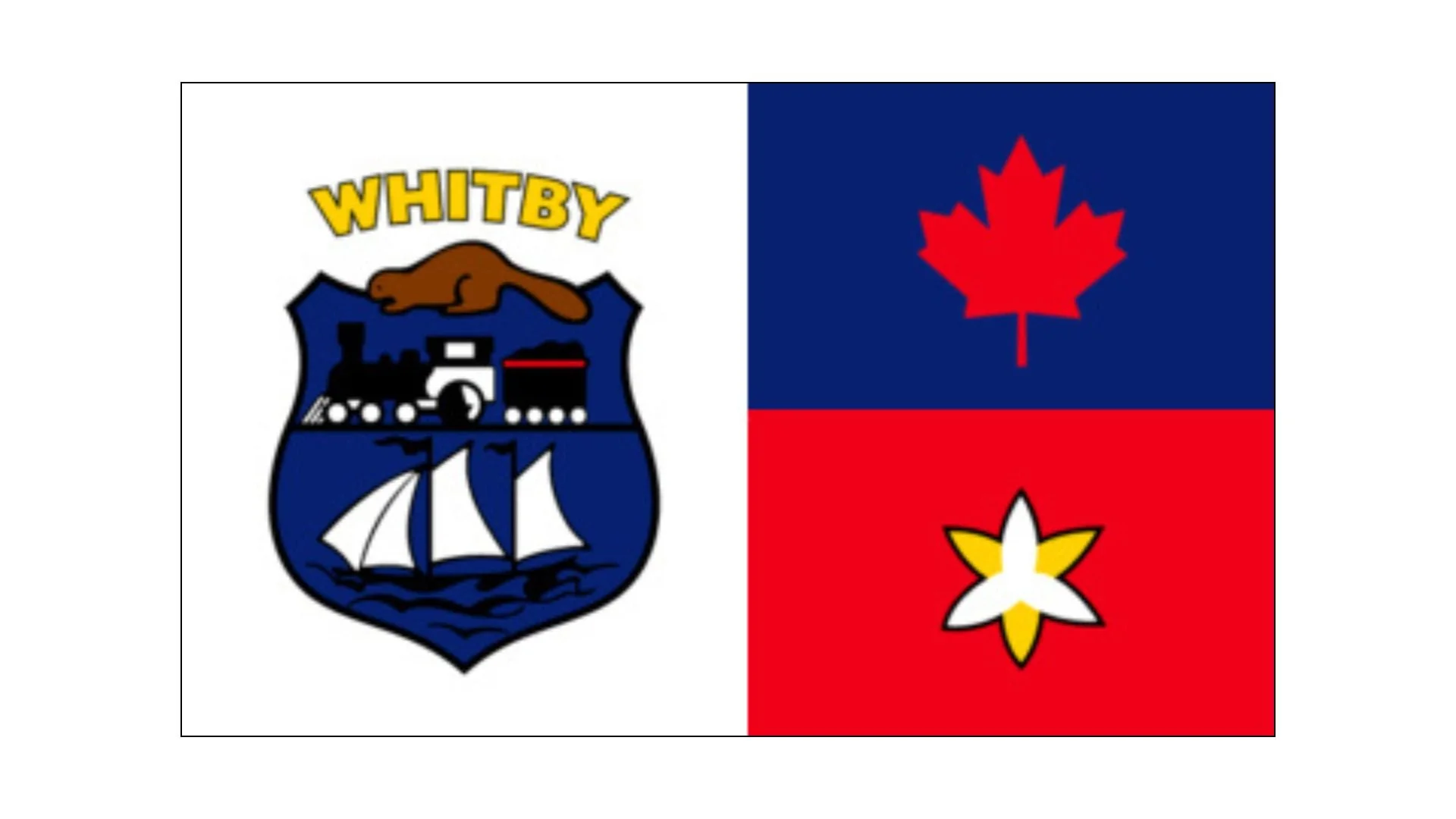
The flag of Whitby, Ontario, is a vibrant heraldic tapestry that encapsulates the town's identity, its provincial roots, and its national pride. Adopted officially in 1969, the flag serves as a visual bridge between the community's storied past and its position within the modern Canadian landscape. By analyzing its distinctive design elements—the town crest, the trillium, and the maple leaf—one can uncover a narrative of industrial growth, natural heritage, and enduring loyalty.
The community's name itself carries deep historical weight, originating from the Danish word "Whitteby," meaning "White Village". This name dates back to approximately 867 AD in England and was brought to Ontario in 1792 by a surveyor who named the townships east of Toronto after locations in Yorkshire. This connection to the "Old World" Whitby is not merely nomenclatural; it is deeply embedded in the town’s heraldry.
The original coat of arms, from which the flag's crest is derived, was officially granted to Whitby's English namesake in 1935. It features three coiled serpents, a reference to the legend of Abbess Hilda, who was said to have turned a plague of snakes into stone. These "stones" were actually ammonite fossils common to the area. While Whitby, Ontario, has developed its own unique industrial and maritime identity, these foundational links to the sea and ancient history remain part of its symbolic DNA.
The flag is divided into three distinct background sections: a large white field on the hoist (left) side and two smaller horizontal bands of blue (top) and red (bottom) on the fly (right) side. Dominating the white field is the Town's Crest, representing the Corporation of the Town of Whitby. This crest is a dense collection of local symbols. Resting atop the shield, the beaver is a quintessential Canadian symbol of industriousness and the fur trade history that helped build the nation. Representing Whitby’s role as a vital transportation hub, the steam engine honors the arrival of the railway in the mid-19th century, which spurred significant economic growth. Below the train, a three-masted ship signifies Whitby’s maritime heritage as a port town on Lake Ontario. The inclusion of gear-like elements or industrial silhouettes within variations of the crest underscores the transition from a pioneer settlement to a modern manufacturing center.
In the upper right blue section sits a red Maple Leaf, the unmistakable emblem of Canada. Its placement here serves as a declaration of national unity. Interestingly, the blue background of this section provides a sharp contrast to the red leaf, a departure from the typical red-and-white pairing of the national flag, emphasizing Whitby’s unique local interpretation of Canadian identity.
The bottom right red section features a White Trillium, the official floral emblem of Ontario. Adopted by the province in 1937, the trillium represents the town's provincial heritage. In the context of the flag, it balances the national maple leaf, grounding Whitby’s local identity within the broader governance and culture of Ontario.
In recent years, Whitby has undergone corporate rebranding efforts to better reflect its status as a "smart, urban town". While modern logos have been introduced for municipal communications, the 1969 flag remains the official ceremonial banner of the community. It is frequently seen at Town Hall and during official flag-raising ceremonies that celebrate local contributions and significant historical dates.
The flag of Whitby is more than a simple banner; it is a compact history book. From its Danish-inspired name to its celebration of railways, ships, and natural beauty, it stands as a testament to a community that is, as its motto suggests, both what it "has been" and what it "is".
Recently Posted



Categories
- Alberta 29
- Armed Forces 41
- British Columbia 27
- Canada 340
- Cities 162
- County / Municipality / Regional District / Township 8
- General Information 2
- Government 18
- Historical 4
- Indigenous 45
- International Flags 59
- International Organizations 5
- Manitoba 19
- Miscellaneous 4
- New Brunswick 10
- Newfoundland 12
- Northwest Territories 7
- Nova Scotia 15
- Nunavut 6
- Ontario 44
- Police 1
- Prince Edward Island 5
- Quebec 78
- Royalty 16
- Saskatchewan 16
- Schools 14
- Sports 29
- Yukon 5