Canadian Forces
Flag of the Canadian Forces
The flag of the Canadian Armed Forces, formally known as the Canadian Forces Ensign, stands as a profound visual testament to a pivotal moment in Canada’s military evolution. More than just a piece of fabric, it is a heraldic synthesis of history, sovereignty, and the functional integration of three distinct fighting services. To understand the significance of this flag, one must look past its aesthetic design and examine the radical administrative shift that birthed it: the unification of 1968.
For most of the 20th century, Canada’s military identity was defined by its British roots and a clear division of labor. The Royal Canadian Navy (RCN), the Canadian Army, and the Royal Canadian Air Force (RCAF) operated as separate entities, each with its own culture, leadership, and symbols. Sailors served under the White Ensign, aviators under the Air Force Blue Ensign, and soldiers followed the banners of their specific regiments. However, the post-war era brought a desire for a more distinctively Canadian identity and a more efficient, unified command structure.
This culminated in the Canadian Forces Reorganization Act of 1968. Under the leadership of Defense Minister Paul Hellyer, the three branches were merged into a single service: the Canadian Armed Forces (CAF). This unification was controversial, as it stripped away the "Royal" prefixes and traditional uniforms that many veterans held dear. In this climate of transition, the Canadian Forces Ensign was created to provide a new, singular focal point for loyalty—a symbol that could represent the unified force to the world.

Canadian Army
The design of the flag is deeply rooted in Commonwealth maritime and military tradition, yet it is unmistakably Canadian. It features a "white field" or background, which serves as a neutral canvas for the symbols it carries. In the upper-left corner, known as the canton, sits the National Flag of Canada. The placement of the Maple Leaf flag in the canton is a deliberate statement of subordination and service; it indicates that the military is an instrument of the Canadian people and their sovereign state. Adopted just three years after the national flag itself, the Ensign was one of the first military applications of the modern Maple Leaf.
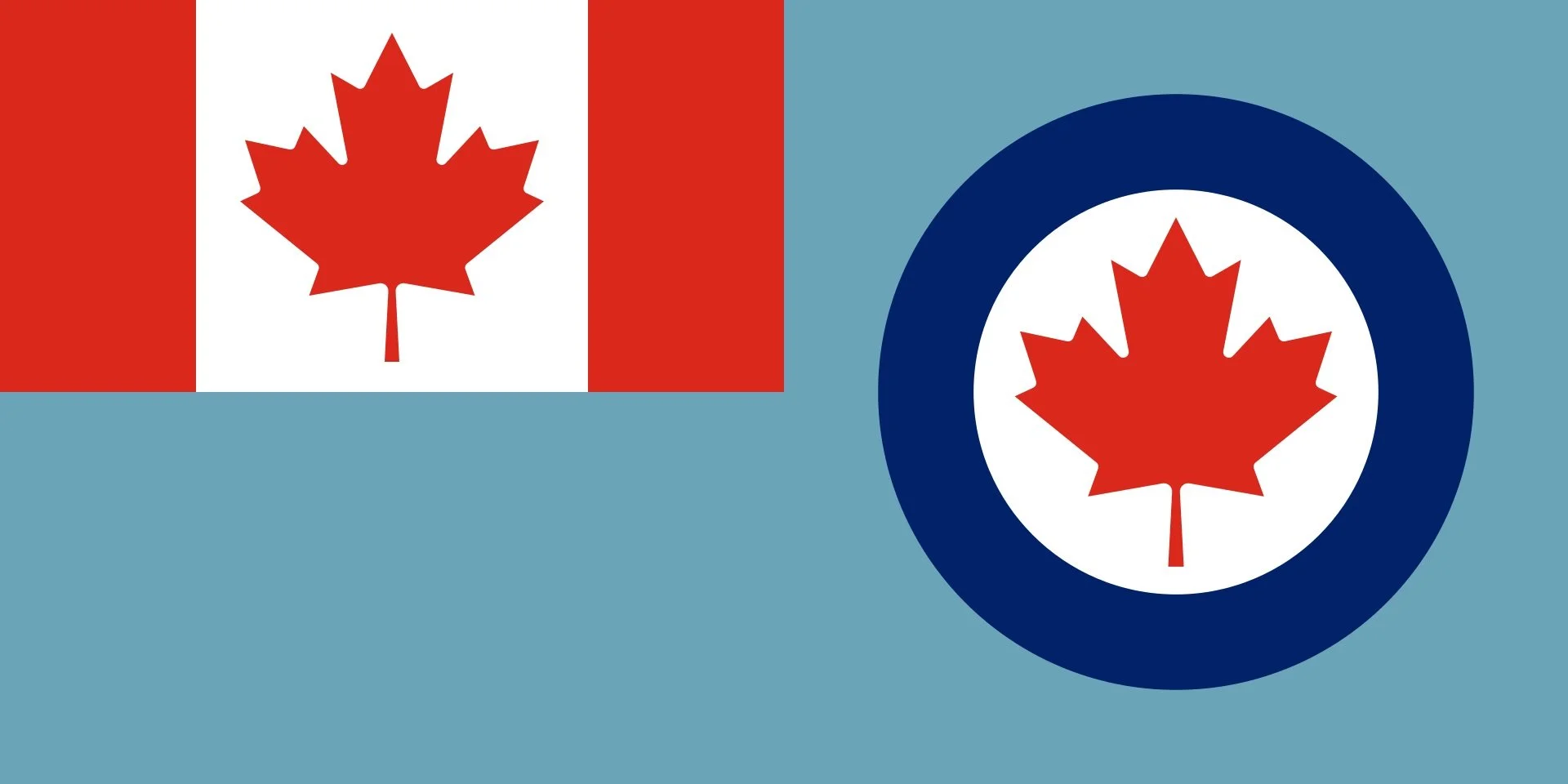
Royal Canadian Air Force
The heart of the flag’s meaning, however, lies in the badge centered in the "fly"—the half of the flag furthest from the hoist. This badge is a masterpiece of symbolic compression. At its center is a fouled anchor, representing the maritime traditions and the Royal Canadian Navy. Overlaid on the anchor is a soaring eagle, representing the Royal Canadian Air Force and the mastery of the skies. Flanking these are two crossed swords, the ancient symbol of the Canadian Army and the ground combatant.

Royal Canadian Navy
These three elements are encircled by a wreath of red maple leaves, signifying the unity of the three branches in the defense of the nation. Crowning the entire assembly is the Royal Crown, which represents the fact that the CAF is a Crown institution, with members swearing their allegiance to the Sovereign of Canada. The crown serves as a bridge to the past, acknowledging that while the organization became "Canadianized," it remained part of a constitutional monarchy with deep historical ties to the Commonwealth.
The Ensign’s role in the daily life of the military is both practical and ceremonial. It is flown at all CAF headquarters, bases, and stations across the country and at international postings. When the Ensign is raised, it signals the presence of a unified Canadian command. While the Navy, Army, and Air Force eventually regained their historic names and their own specific ensigns for environmental use, the Canadian Forces Ensign remains the overarching banner for the entire organization. It is the flag that represents the "purple" trades—those roles like medicine, logistics, and military police that serve all branches equally.
In conclusion, the flag of the Canadian Armed Forces is a symbol of a modern military that has successfully balanced the weight of tradition with the necessity of change. It honors the separate heritages of the sailor, the soldier, and the aviator, while binding them together under a single national identity. For the men and women who serve, the Ensign is a reminder that regardless of the element in which they fight—be it sea, land, or air—they do so as part of one integrated team, dedicated to the protection of Canada and the values represented by the Maple Leaf in its corner.
Recently Posted


Categories
- Alberta 24
- Armed Forces 35
- British Columbia 21
- Canada 285
- Cities 139
- County / Municipality / Regional District / Township 5
- Government 17
- Historical 3
- Indigenous 36
- International Flags 52
- International Organizations 5
- Manitoba 17
- Miscellaneous 3
- New Brunswick 6
- Newfoundland 12
- Northwest Territories 5
- Nova Scotia 12
- Nunavut 6
- Ontario 37
- Police 1
- Prince Edward Island 5
- Quebec 62
- Royalty 13
- Saskatchewan 12
- Schools 10
- Sports 22
- University 1
- Yukon 4