The Flag of the Czech Republic
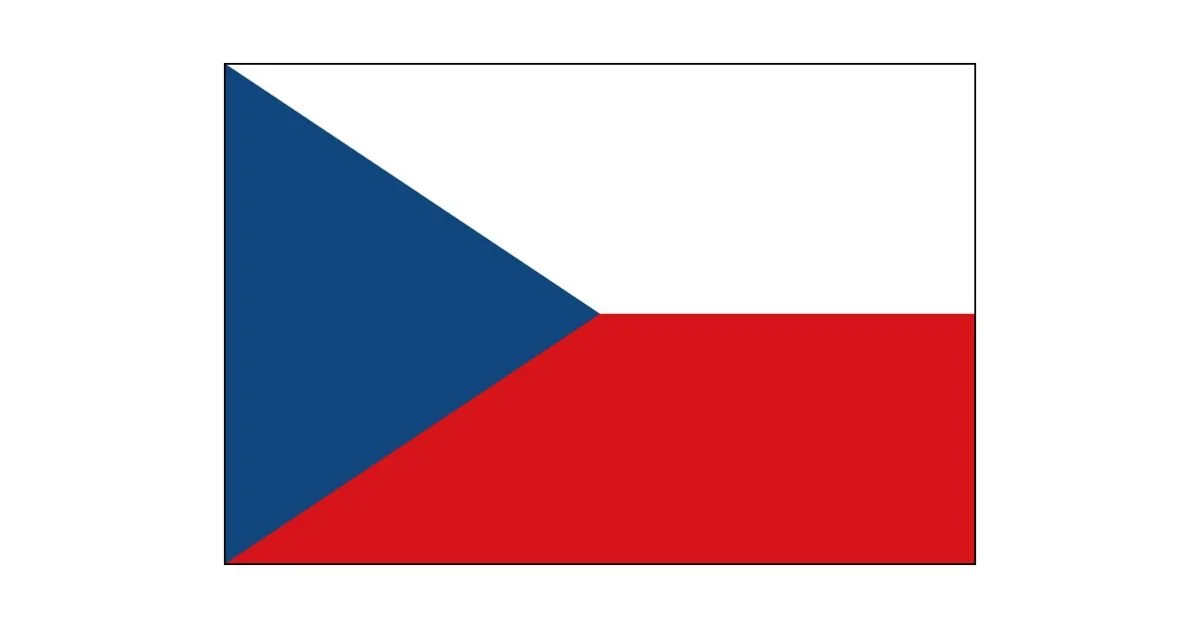
The flag of the Czech Republic is a simple yet striking symbol of national identity, resilience, and historical continuity. Consisting of two horizontal bands—white on the top and red on the bottom—with a blue triangle extending from the hoist side, the flag reflects both the country’s Slavic heritage and its journey through a complex history of statehood, union, and independence. Though now representing the Czech Republic, the flag was originally designed for Czechoslovakia, and its continued use illustrates a deep connection to the past.
The design of the Czech flag dates back to 1920, two years after the formation of Czechoslovakia in the aftermath of World War I. The original idea was to differentiate the new country from other nations, particularly Poland, whose flag is a similar white-over-red bicolour. To avoid confusion, a blue isosceles triangle was added to the hoist side of the flag. The blue not only solved the issue of visual similarity but also added a third colour from the Pan-Slavic palette—white, blue, and red—commonly used to symbolize Slavic unity and brotherhood. These colours were originally inspired by the flag of Russia and adopted by many Slavic nations in the 19th and 20th centuries.
Symbolically, the colours of the Czech flag carry national and cultural meaning. White represents the peaceful and honest nature of the Czech people, as well as the snowy peaks of the country’s mountains. Red stands for courage, valor, and the sacrifices made in the name of independence and liberty. Blue symbolizes vigilance, truth, and loyalty, as well as the Moravian region of the country. Together, the colours unite the diverse histories and identities of Bohemia, Moravia, and Czech Silesia.
After the dissolution of Czechoslovakia in 1993—known as the Velvet Divorce—the Czech Republic retained the flag of the former federation, despite initial legal agreements suggesting that neither successor state would use the old symbols. Slovakia adopted a new flag, while the Czechs kept the familiar banner, reinforcing a sense of national continuity. This decision was not without controversy, but the overwhelming public and governmental support for maintaining the flag underscored its deep-rooted significance in Czech identity.
The flag of the Czech Republic is widely flown on national holidays, at government buildings, sporting events, and during moments of national celebration or mourning. It serves as a visual anchor for citizens, both at home and abroad, and as a representation of a modern European nation with strong democratic traditions and a proud historical legacy.
Recently Posted




Categories
- Alberta 28
- Armed Forces 40
- British Columbia 26
- Canada 333
- Cities 160
- County / Municipality / Regional District / Township 8
- General Information 2
- Government 18
- Historical 4
- Indigenous 42
- International Flags 59
- International Organizations 5
- Manitoba 18
- Miscellaneous 4
- New Brunswick 10
- Newfoundland 12
- Northwest Territories 7
- Nova Scotia 14
- Nunavut 6
- Ontario 42
- Police 1
- Prince Edward Island 5
- Quebec 77
- Royalty 16
- Saskatchewan 16
- Schools 13
- Sports 28
- Yukon 5