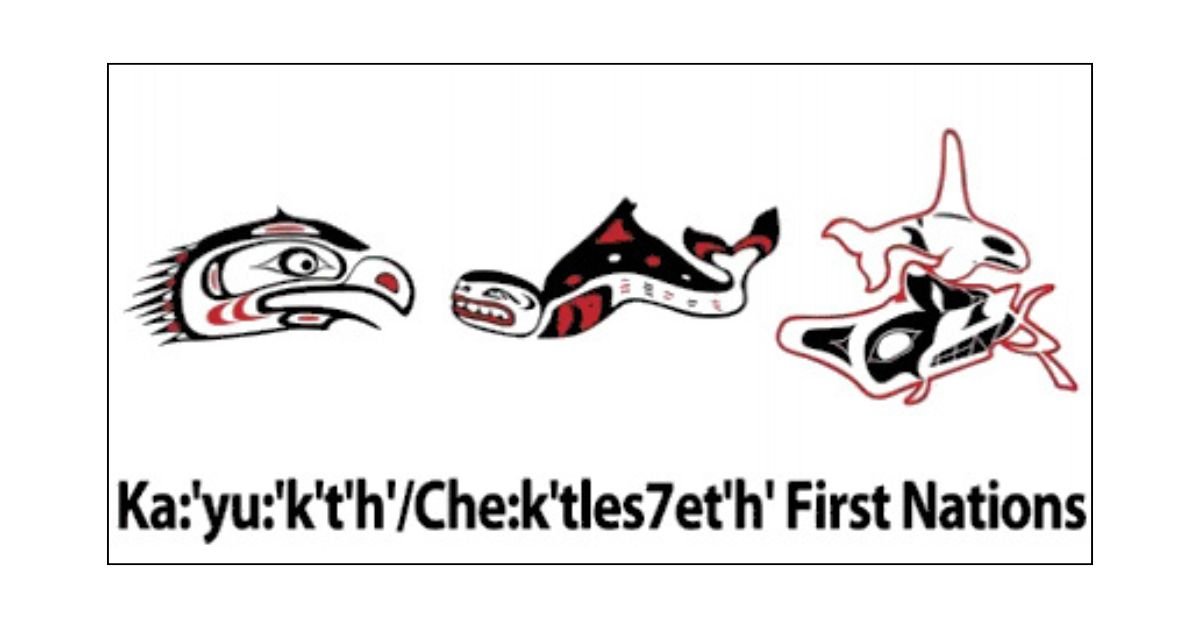
The flag of the Ka:'yu:'k't'h'/Che:k:tles7et'h' First Nation
The flag of the Ka:'yu:'k't'h'/Che:k'tles7et'h' First Nations is a compelling visual statement of Indigenous identity, cultural resilience, and a deep-rooted connection to the natural world. Composed of three powerful animal figures—likely a salmon, a sea serpent, and orca whales—drawn in traditional Nuu-chah-nulth artistic style, the flag is a modern emblem grounded in ancestral knowledge and values.
The Ka:'yu:'k't'h'/Che:k'tles7et'h' First Nations are located on the rugged west coast of Vancouver Island in British Columbia. Their communities are part of the Nuu-chah-nulth Tribal Council and speak the Nuučaan̓uɫ language, one of many languages of the Wakashan family. Historically known as the Kyuquot and Cheklesahht peoples, the two nations amalgamated in the mid-20th century and now operate together as a self-governing First Nation under the Maa-nulth Treaty, which came into effect in 2011. Their flag reflects this joint identity while honouring the unique stories and spiritual traditions passed down through generations.
At the center of the flag’s visual symbolism are three stylized animals—each one significant within coastal Indigenous cosmology.
On the left, the image appears to depict a salmon, a central figure in the lifeways of Pacific Northwest Indigenous peoples. Salmon are not only a vital food source but also symbolize renewal, sustenance, and the cyclical relationship between people and the environment. Its bold black and red lines emphasize the animal’s strength and endurance, mirroring the community’s own survival and adaptation.
In the middle, the image resembles a sea serpent or sea creature, possibly a mythological being like a Sisiutl or another guardian of the waters. In many West Coast cultures, sea serpents represent power, transformation, and spiritual guidance. They are protectors of sacred spaces and are often associated with great leaders. This figure may also reflect the community’s intimate relationship with the ocean, both as a source of livelihood and as a spiritual realm.
On the right, the flag shows a pair of orca whales, intricately drawn with faces embedded within their bodies. Orcas are considered family protectors, symbols of unity, and beings of great intelligence. In Nuu-chah-nulth stories, orcas are believed to embody ancestors and guide the living. The presence of multiple orcas may also represent the unity of the two Nations—Ka:'yu:'k't'h' and Che:k'tles7et'h'—now moving forward together.
Beneath the imagery, the full name of the nation is written in its current official form: Ka:'yu:'k't'h'/Che:k'tles7et'h' First Nations. The use of accurate Indigenous orthography including apostrophes and glottal stops, demonstrates the community’s commitment to language revitalization and self-determination. This spelling asserts control over how their name is presented and understood, challenging colonial simplifications or anglicizations.
As a whole, the flag serves multiple purposes: it marks political identity, asserts land and treaty rights, and celebrates cultural heritage. It is likely flown at governance buildings, public gatherings, treaty signings, and cultural events. It also communicates to the wider world that this First Nation is proud, sovereign, and deeply rooted in its lands and traditions.
Recently Posted



Categories
- Alberta 27
- Armed Forces 39
- British Columbia 22
- Canada 314
- Cities 152
- County / Municipality / Regional District / Township 6
- General Information 1
- Government 18
- Historical 4
- Indigenous 40
- International Flags 56
- International Organizations 5
- Manitoba 17
- Miscellaneous 4
- New Brunswick 8
- Newfoundland 12
- Northwest Territories 7
- Nova Scotia 14
- Nunavut 6
- Ontario 41
- Police 1
- Prince Edward Island 5
- Quebec 70
- Royalty 15
- Saskatchewan 14
- Schools 12
- Sports 25
- Yukon 4