Canadian Military Police Branch
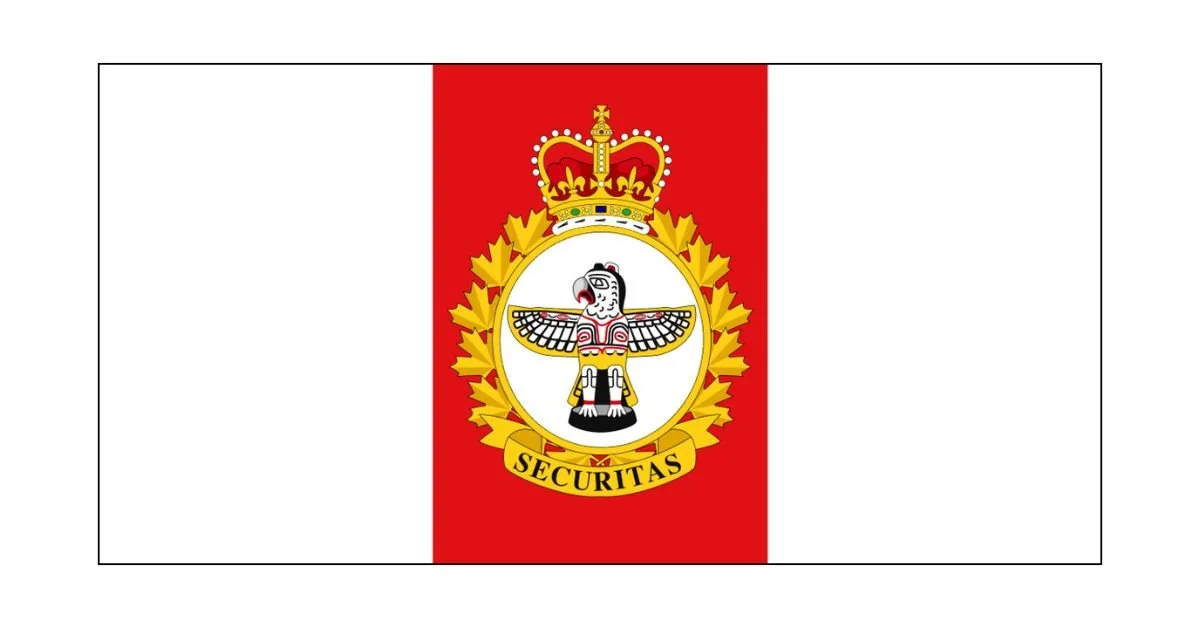
Flag of Canadian Military Police Branch
The flag of the Military Police Branch of the Canadian Armed Forces is a distinctive symbol that speaks to its identity, heritage and role within Canada’s military structure. Adopted in its current form in 2000 when the branch assumed its present name (having previously been the Security Branch), the flag retains a design originally approved in 1976.
At its simplest, the flag features a white field, centrally charged by a vertical red stripe (often a pale, one-third the width) bearing the branch badge — the so-called “Thunderbird” — surrounded by a gold maple-leaf wreath and surmounted by a St Edward’s Crown, with the scroll beneath bearing the motto SECURITAS. The white-and-red design pays homage to the national colours of Canada, signalling the branch’s service to the country. The red vertical band draws focus to the badge and to the branch’s role in policing, security and military justice.
The Thunderbird emblem is deeply symbolic: derived from Indigenous Northwest Pacific Coast art, the Thunderbird is a mythical spirit, often depicted as an eagle-like being whose name signifies “voice of thunder”. In First Nations tradition it is a protector, a guardian who gives counsel and shields the tribe from misfortune. For the Military Police Branch this makes it a fitting emblem: the branch’s functions include policing, security, oversight and investigation, and thus protecting the Canadian Armed Forces and by extension Canadian society. The maple-leaf wreath encircling the Thunderbird reinforces the Canadian identity of the branch and its service across the country.
Historically, the lineage of the branch goes back to the Canadian Provost Corps (established 15 June 1940) and later the unified Canadian Forces from 1 February 1968. The flag’s earlier version (as for the Security Branch) was adopted in 1976. When the branch was renamed in 2000 to “Military Police Branch”, the flag was retained as the branch flag in its existing form.
In terms of usage, this is what is often termed a “branch flag” or “camp flag” — used to identify the personnel branch of the Canadian Armed Forces rather than a unit or regiment per se. According to Canadian Forces doctrine, camp and branch flags are “distinctive symbols or emblems used to visually identify a military organization and foster the pride and continuity necessary for operational effectiveness.” As such, the flag may be displayed at Headquarters, at branch functions or events, or in contexts where branch representation is required.
Beyond its formal appearance, the flag communicates several layered meanings:
The national identity of the branch (white and red = Canada)
The singular nature of the branch within the military structure (central badge)
The protective, policing role of the branch (Thunderbird as guardian)
Continuity and heritage (the crown, the maple leaves, the badge lineage)
One interesting note: while many might assume that the badge or flag would explicitly reference prior corps (such as army provost units), the selection of the Thunderbird emblem was carried out in the late 1960s by an Insignia Steering Group that deliberately sought a symbol not tied to past corps so as to reflect a unified approach across service branches (army, navy, air) in the forthcoming unification of the Canadian Forces.
Recently Posted


Categories
- Alberta 24
- Armed Forces 37
- British Columbia 22
- Canada 297
- Cities 144
- County / Municipality / Regional District / Township 6
- Government 17
- Historical 3
- Indigenous 37
- International Flags 54
- International Organizations 5
- Manitoba 17
- Miscellaneous 4
- New Brunswick 7
- Newfoundland 12
- Northwest Territories 5
- Nova Scotia 13
- Nunavut 6
- Ontario 39
- Police 1
- Prince Edward Island 5
- Quebec 66
- Royalty 13
- Saskatchewan 13
- Schools 11
- Sports 24
- Yukon 4