The flag of Tide Head, New Brunswick
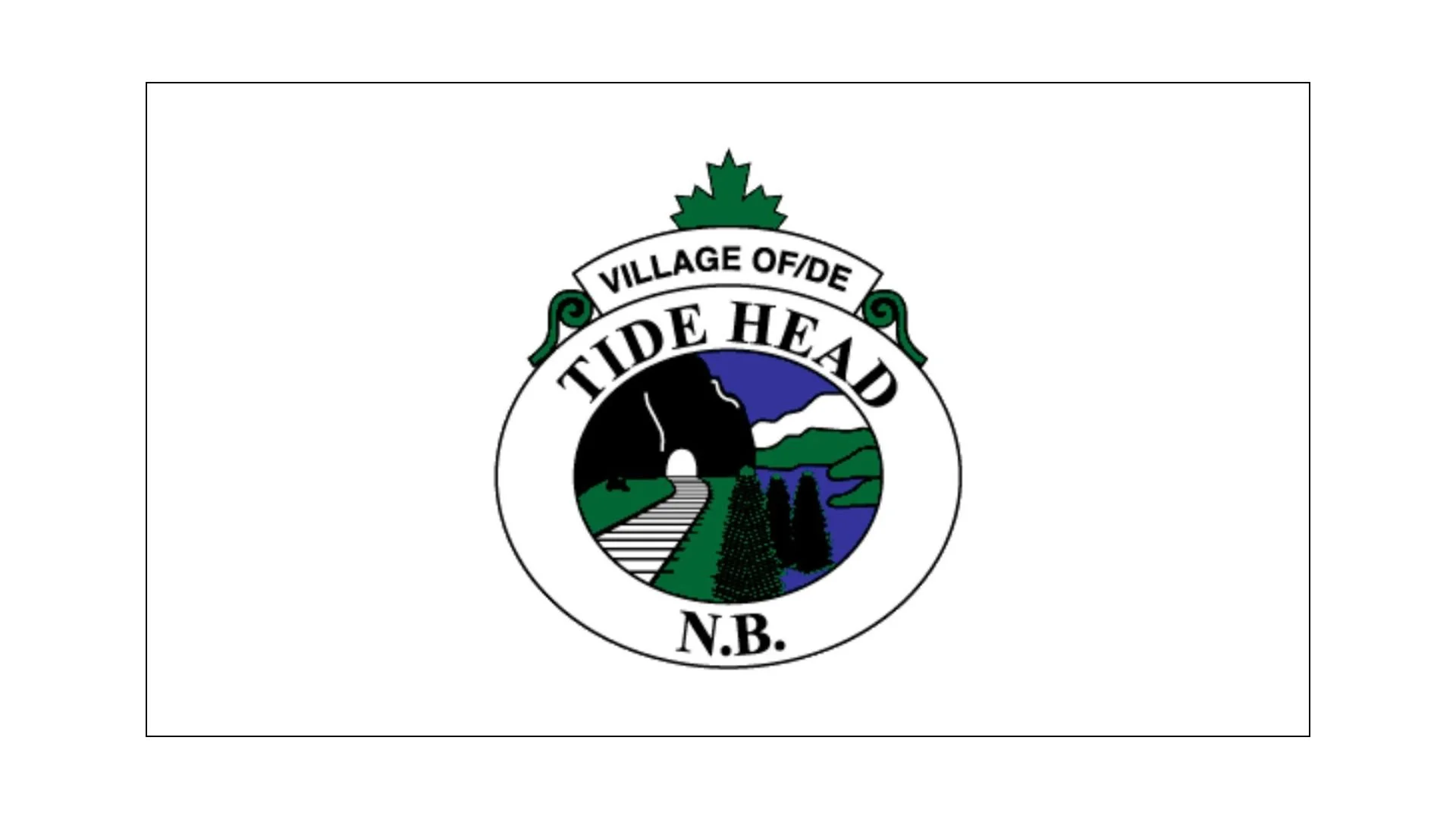
The flag of Tide Head, New Brunswick, serves as a visual chronicle of a unique geographical phenomenon and a storied industrial past. Unlike many municipal flags that rely on abstract heraldry, Tide Head’s banner is a "seal-on-bedsheet" design, featuring the village’s detailed, scenic logo centered on a white field. Within this oval emblem lies the narrative of a community defined by the meeting of the river and the sea, and the iron rails that pierced its hills.
The very name "Tide Head" is an literal descriptor of the village's location on the south bank of the Restigouche River, approximately 10 kilometers west of Campbellton. It marks the exact point where the influence of the Bay of Fundy tides, traveling up the river, finally ceases to be visible.
This geographical boundary is central to the community's identity and is reflected in the scenic elements of the flag's logo. The logo depicts a river winding through a lush landscape of woods and hills under a clear sky, representing the Restigouche—a designated Canadian Heritage River and the village's primary natural attraction.
The most striking feature within the flag’s central emblem is the depiction of a railway track disappearing into a tunnel. This represents the tunnel at Morrissey Rock, a landmark of immense local pride and historical significance.
Construction on the railway through Tide Head began in 1875, with the first train heading west in 1878. To navigate the rugged terrain, engineers were forced to bore through the hillside of Morrissey Rock. This resulted in what remains the only active railway tunnel in the entire Maritime provinces. Its inclusion on the flag highlights how the railway was not just a means of transport, but a transformative force that spurred the development of prosperous new parishes in the early 20th century.
While not explicitly illustrated in the central landscape, the flag’s green accents and the surrounding community lore celebrate Tide Head's unofficial title: the "Fiddlehead Capital of the World". Each spring, from mid-May to early June, a "fiddlehead frenzy" takes over the village as residents and visitors harvest the young, furled fronds of ostrich ferns from the islands in the Restigouche River. This seasonal staple is a cornerstone of local culture, celebrated in restaurants and roadside stands throughout the region.
The community represented by the flag has deep roots in Scottish settlement. Early farms were established by families such as the Moffats, Gerrards, and Adams, many of whom are interred in the Athol House Cemetery—the oldest British cemetery in Restigouche County, with graves dating back to 1791.
Tide Head officially incorporated as a village in 1966, with Jim Adams serving as its first mayor. For over half a century, it maintained its independence until January 1, 2023, when it was amalgamated with the city of Campbellton and the village of Atholville. Despite this administrative change, the name Tide Head remains in official use, and its flag continues to stand as a symbol of the community's distinct heritage.
The flag’s design follows a traditional municipal format. The white background provides a clean, neutral background that allows the colorful logo to stand out. The oval scene on the logo captures the essence of the local environment—water, forest, and sky. The outer ring clearly identifies the community with the bilingual text "VILLAGE OF/DE TIDE HEAD" and the provincial abbreviation "N.B.". As well, adding the maple leaf, Often found surmounting firmly roots the community within the Canadian national identity.
The flag of Tide Head is a "landscape in miniature," capturing the intersection of natural beauty and human ingenuity. From the unique "head of the tide" that gave the village its name to the historic Morrissey Rock tunnel that connected it to the wider world, every element on the banner tells a story of a resilient, predominantly English-speaking community. Even as an amalgamated part of Campbellton, Tide Head’s identity—and the flag that represents it—remains a vital part of New Brunswick's cultural tapestry.
Recently Posted


Categories
- Alberta 27
- Armed Forces 40
- British Columbia 24
- Canada 321
- Cities 155
- County / Municipality / Regional District / Township 7
- General Information 1
- Government 18
- Historical 4
- Indigenous 40
- International Flags 57
- International Organizations 5
- Manitoba 17
- Miscellaneous 4
- New Brunswick 9
- Newfoundland 12
- Northwest Territories 7
- Nova Scotia 14
- Nunavut 6
- Ontario 41
- Police 1
- Prince Edward Island 5
- Quebec 72
- Royalty 15
- Saskatchewan 15
- Schools 13
- Sports 26
- Yukon 4