Columbia
The Flag of Columbia
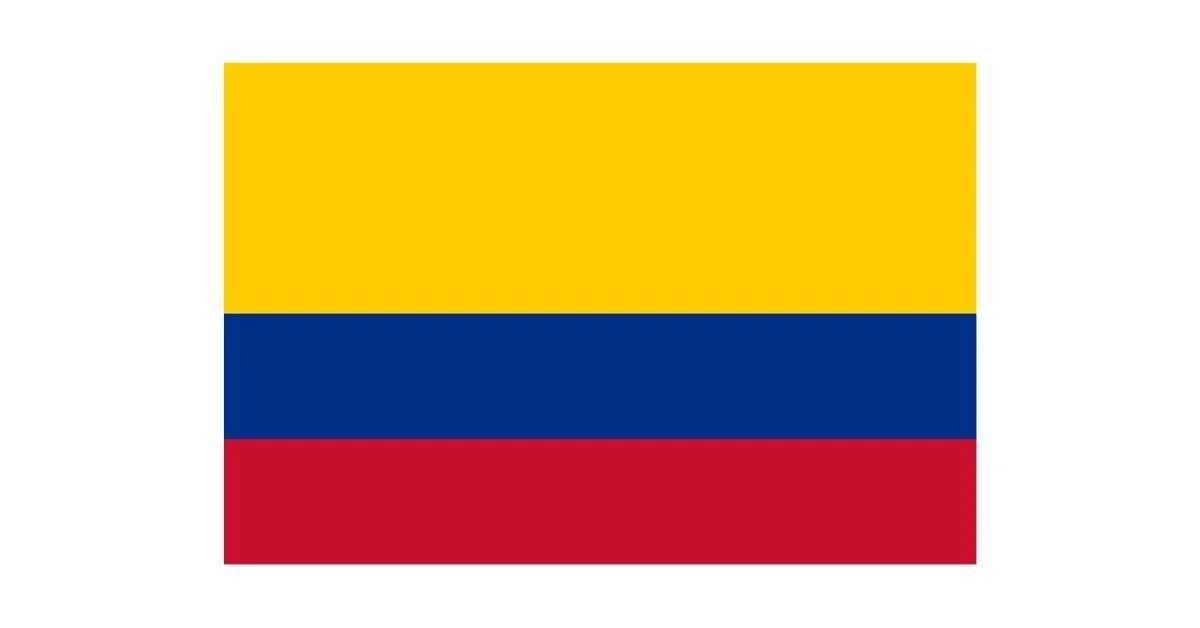
The flag of Colombia is a powerful and vibrant national symbol that reflects the country’s history, identity, and ideals. Its simple yet striking tricolour design—comprised of horizontal stripes of yellow, blue, and red—has its origins in the early 19th century, during the time of Latin American independence movements. The current form of the flag was officially adopted on November 26, 1861, though its roots trace back to the era of the revolutionary leader Francisco de Miranda, who envisioned a united and independent Latin America.
The flag of Colombia features three horizontal bands. The top stripe is yellow and takes up half the flag’s total height, while the remaining half is split evenly between blue and red. This asymmetrical layout makes the Colombian flag unique among the former members of Gran Colombia (which included Venezuela and Ecuador), who adopted similar designs with equal stripes.
Each colour on the flag carries deep meaning, though interpretations can vary. The yellow symbolizes Colombia’s wealth in natural resources—especially gold—as well as the sun and the country's rich agricultural potential. It is also associated with sovereignty and justice. The blue represents the sky above Colombia and its access to both the Pacific and Atlantic Oceans. It also stands for liberty and the importance of Colombia’s waterways in its development. The red commemorates the blood shed by patriots during Colombia’s struggle for independence from Spain. It reflects courage, resilience, and the sacrifices made in the name of freedom. Together, these colours express a balance of prosperity, independence, and bravery—central tenets in Colombia’s national identity.
The Colombian flag has its roots in the ideals of independence championed by figures such as Francisco de Miranda and Simón Bolívar. Miranda is credited with creating the tricolour scheme of yellow, blue, and red, inspired by Enlightenment principles and the flag of the Dutch Republic. Bolívar, who led Colombia and several other nations to independence from Spanish rule, adopted this colour scheme for the short-lived Republic of Gran Colombia, which included present-day Colombia, Ecuador, Venezuela, and Panama. After Gran Colombia dissolved in 1831, each country created its own version of the original tricolour. Colombia’s flag retained the foundational colours but with the distinctive proportion of the yellow stripe being twice the width of the others.
The Colombian national flag is widely used in official and ceremonial contexts, as well as by civilians during national celebrations such as Independence Day (July 20). A variant of the flag used by the military includes the national coat of arms centered within the yellow stripe, reserved for government and state use.
Recently Posted


Categories
- Alberta 24
- Armed Forces 36
- British Columbia 22
- Canada 295
- Cities 143
- County / Municipality / Regional District / Township 6
- Government 17
- Historical 3
- Indigenous 37
- International Flags 54
- International Organizations 5
- Manitoba 17
- Miscellaneous 4
- New Brunswick 7
- Newfoundland 12
- Northwest Territories 5
- Nova Scotia 13
- Nunavut 6
- Ontario 39
- Police 1
- Prince Edward Island 5
- Quebec 65
- Royalty 13
- Saskatchewan 13
- Schools 11
- Sports 24
- Yukon 4