Isle Madame Boat Club
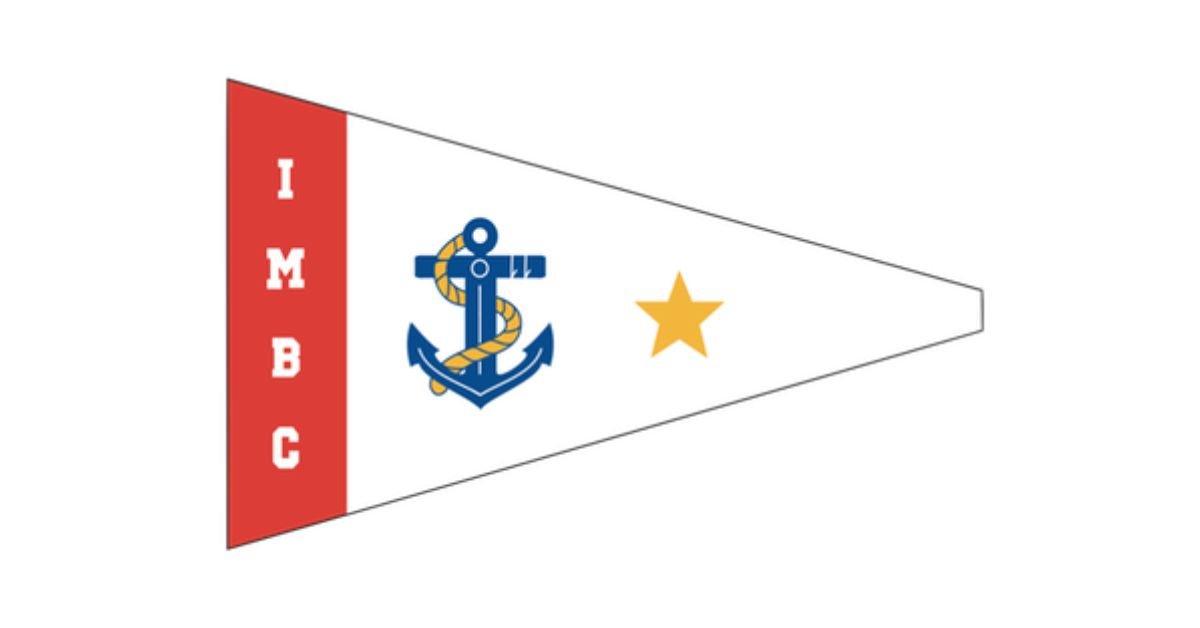
Burgee of the Isle Madame Boat Club
The Isle Madame Boat Club (IMBC), located in Arichat, Nova Scotia, is more than a marina—it is an institution rooted in maritime history, local culture, and community pride. Founded in 1976 (initially as the Arichat Boat Club), the club adopted its current name in 1986. Its burgee, the distinctive flag flown by its vessels and displayed at the clubhouse, encapsulates much of this heritage. The flag’s design elements tell a story—not just of navigation and coastal life, but of identity, community, and regional pride.
Visually, the burgee is a pennant—somewhat truncated in shape—with an approximate ratio of 6 (length) to 10 (width) when viewed in web images. The flag’s base field is white, serving as a clean backdrop for the other elements: a red vertical stripe next to the hoist bearing the white letters “IMBC,” a blue fouled anchor, and a yellow star near the fly. Each of these components carries meaning.
To begin with, the red stripe running vertically near the hoist is bold and eye-catching. Against its rich red ground, the white letters “IMBC” are placed, immediately proclaiming the club’s identity. The choice of red suggests passion, energy, and vitality—qualities befitting a boating organization in a scenic, active maritime setting. It also provides strong contrast with the stark white background, making the lettering immediately legible even from a distance.
Moving outward from the hoist, around three units from it, is a blue anchor. But this is not a plain anchor—it is “fouled,” meaning it is wrapped or entangled with its line (the “rode”). The anchor is blue, while the rode is yellow. Anchors are a common motif in nautical flags, symbolizing safety, stability, shelter, and trust. The fouled anchor in particular is a time-honoured signal in maritime tradition, often indicating that the anchor has been used or is not clean—yet in heraldry and flags it can mean the interconnectedness of maritime life, the complexity and hands-on reality of anchoring, handling ships, and the dependence on both skill and equipment. The blue colour evokes the sea, the harbour, and navigation; the yellow of the rode suggests warmth, light, perhaps hope and community cooperation.
Towards the fly (roughly six units from the hoist), there is a yellow star. This star is widely understood to be a nod to the Acadian heritage of Isle Madame, since the yellow star is a feature of the Acadian flag (where a yellow star appears on the French tricolour in the canton). Isle Madame has a strong Acadian presence and history, and this symbol ties the club to that cultural legacy. It simultaneously signals a sense of place, history, and identity beyond mere geography.
Putting these pieces together—the red stripe and club initials at the hoist, the blue fouled anchor with yellow rode, and the yellow star—all set against white—the burgee becomes more than just a flag. It becomes a compact statement: “We are IMBC. We are part of the sea. We honour tradition. We belong to Isle Madame with its Acadian roots. We offer shelter and community to vessels and sailors alike.” The white background suggests openness, clarity, perhaps peace and hospitality. The proportions and ordering of symbols balance identity (initials), nautical function (anchor), and cultural identity (star).
Historically, burgees like this play an important role in boating culture: they allow members to signal membership, identity, and pride; they fly from ships, masts, spreaders, or bow staffs; they appear in clubhouses; they are exchanged between clubs. The IMBC burgee is no exception: it is a symbol to be flown when vessels are in harbour or out, a visual marker of IMBC’s presence, generosity, and stewardship in Isle Madame’s maritime community.
Recently Posted

Categories
- Alberta 24
- Armed Forces 36
- British Columbia 21
- Canada 293
- Cities 142
- County / Municipality / Regional District / Township 6
- Government 17
- Historical 3
- Indigenous 37
- International Flags 53
- International Organizations 5
- Manitoba 17
- Miscellaneous 4
- New Brunswick 7
- Newfoundland 12
- Northwest Territories 5
- Nova Scotia 13
- Nunavut 6
- Ontario 39
- Police 1
- Prince Edward Island 5
- Quebec 64
- Royalty 13
- Saskatchewan 13
- Schools 11
- Sports 23
- Yukon 4