For nearly a century after Confederation in 1867, Canada existed as a nation without a uniquely identifiable, legally authorized national flag. Instead, the country relied on the Canadian Red Ensign for general purposes and the British Royal Union Flag (Union Jack) to symbolize its official allegiance to the British Crown. This dual reliance reflected a deeply rooted duality within the Canadian populace: a desire for distinct autonomy coupled with an intense emotional and historical loyalty to the British Empire.
By the mid-20th century, this compromise became increasingly unsustainable. The Great Canadian Flag Debate of 1964 emerged as one of the most passionate, polarizing, and defining political battles in the nation's history. Sparked by Prime Minister Lester B. Pearson’s determination to establish a distinct national symbol, the debate transcended mere aesthetics. It exposed profound fractures along linguistic, generational, and regional lines, ultimately forcing Canadians to confront the fundamental question of their national identity. The creation of the National Flag of Canada—the single-leaf Maple Leaf—marked a pivotal transition from a Dominion defined by its colonial past to an independent, multicultural nation looking toward its own future.
To understand the intensity of the 1964 flag debate, one must examine the complex tapestry of Canada's early symbolic history. Following Confederation, Canada did not possess a formal mechanism or an immediate cultural consensus to create its own flag. The Union Jack remained the official national flag, representing Canada’s status as a British Dominion.
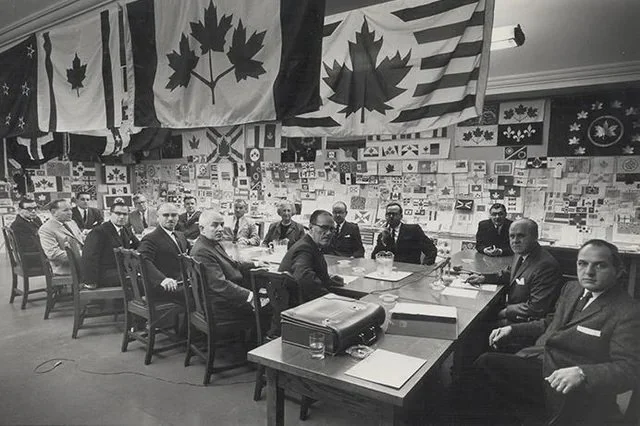
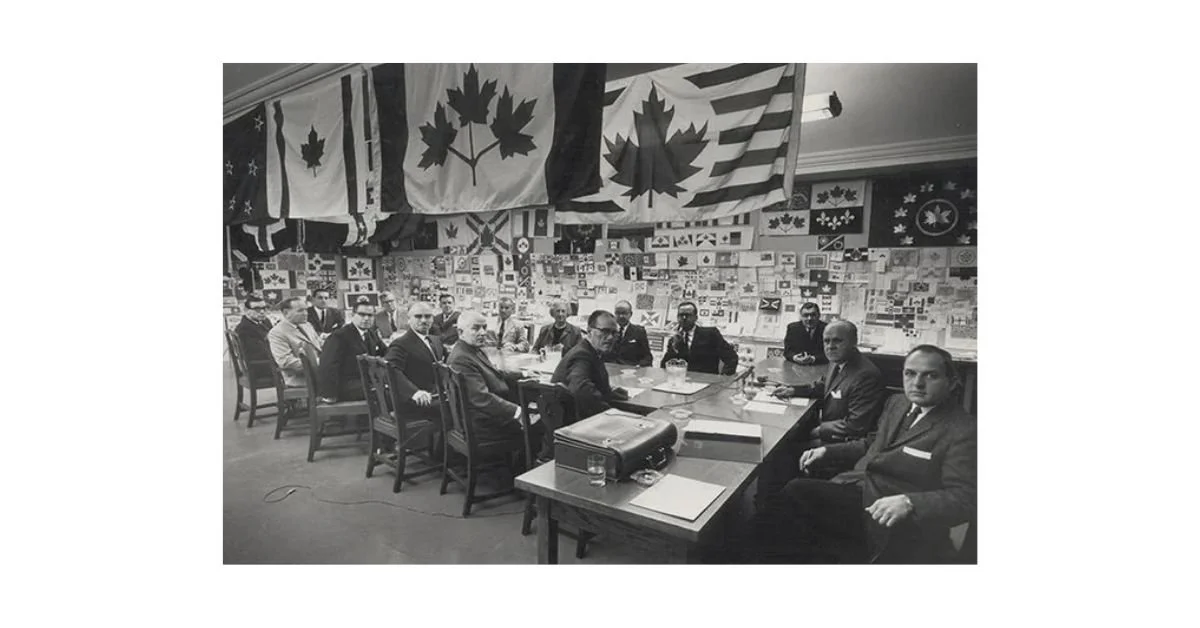
The 15-member flag committee, 1964.
©Cliff Buckman, PA-213164 Library and Archives Canada
Over time, the Canadian Red Ensign grew in popularity. This flag featured a red field with the Union Jack in the upper left corner (the canton) and, eventually, the shield of the Coat of Arms of Canada in the fly. Initially used as a civil ensign for Canadian shipping, the Red Ensign was progressively adopted by the government for use on federal buildings outside of Ottawa. In 1945, an Order-in-Council authorized its temporary use on federal buildings within Canada until Parliament could choose a permanent design.
However, the Red Ensign was a deeply divisive symbol. For English-speaking Canadians, particularly those of British descent, the flag was a badge of honor. It represented Canada's participation in the British Empire, its legal and political traditions, and the immense sacrifices made by Canadian soldiers under the Ensign during World War I and World War II. For these citizens, abandoning the Red Ensign felt like an act of betrayal toward the veterans and the historical foundation of the country.
Conversely, for French-speaking Canadians, predominantly concentrated in Quebec, the Red Ensign was a symbol of British imperialism and conquest. It served as a constant visual reminder of their minority status within a British-dominated dominion. This alienation intensified during the 1960s with the onset of the Quiet Revolution in Quebec—a period of rapid secularization, modernization, and rising Quebec nationalism.
As Quebec sought greater autonomy and reassessed its place within Confederation, the federal government faced an urgent imperative. To preserve national unity, Ottawa needed to foster a pan-Canadian identity that could accommodate French Canada while acknowledging the country’s growing demographic diversity due to post-war immigration.
The catalyst for resolving this long-standing issue was Lester B. Pearson, who became Prime Minister in 1963 leading a minority Liberal government. Pearson was a seasoned diplomat, having won the Nobel Peace Prize in 1957 for his role in resolving the Suez Crisis through the deployment of a United Nations peacekeeping force.
It was during the Suez Crisis that Pearson directly experienced the limitations of Canada's colonial iconography. When Canada offered to send troops as peacekeepers, the Egyptian government objected, noting that Canadian troops wore the Red Ensign, which featured the Union Jack—the flag of Great Britain, one of the primary aggressors in the conflict. This diplomatic embarrassment convinced Pearson that Canada urgently required a distinct flag that could not be confused with British colonial apparatus.
In his 1963 election campaign, Pearson made a definitive promise: he would give Canada a unique national flag within two years of taking office. Upon winning, he moved swiftly to fulfill this pledge, viewing it as a vital project to unify the country and ease the growing separatist tensions in Quebec.
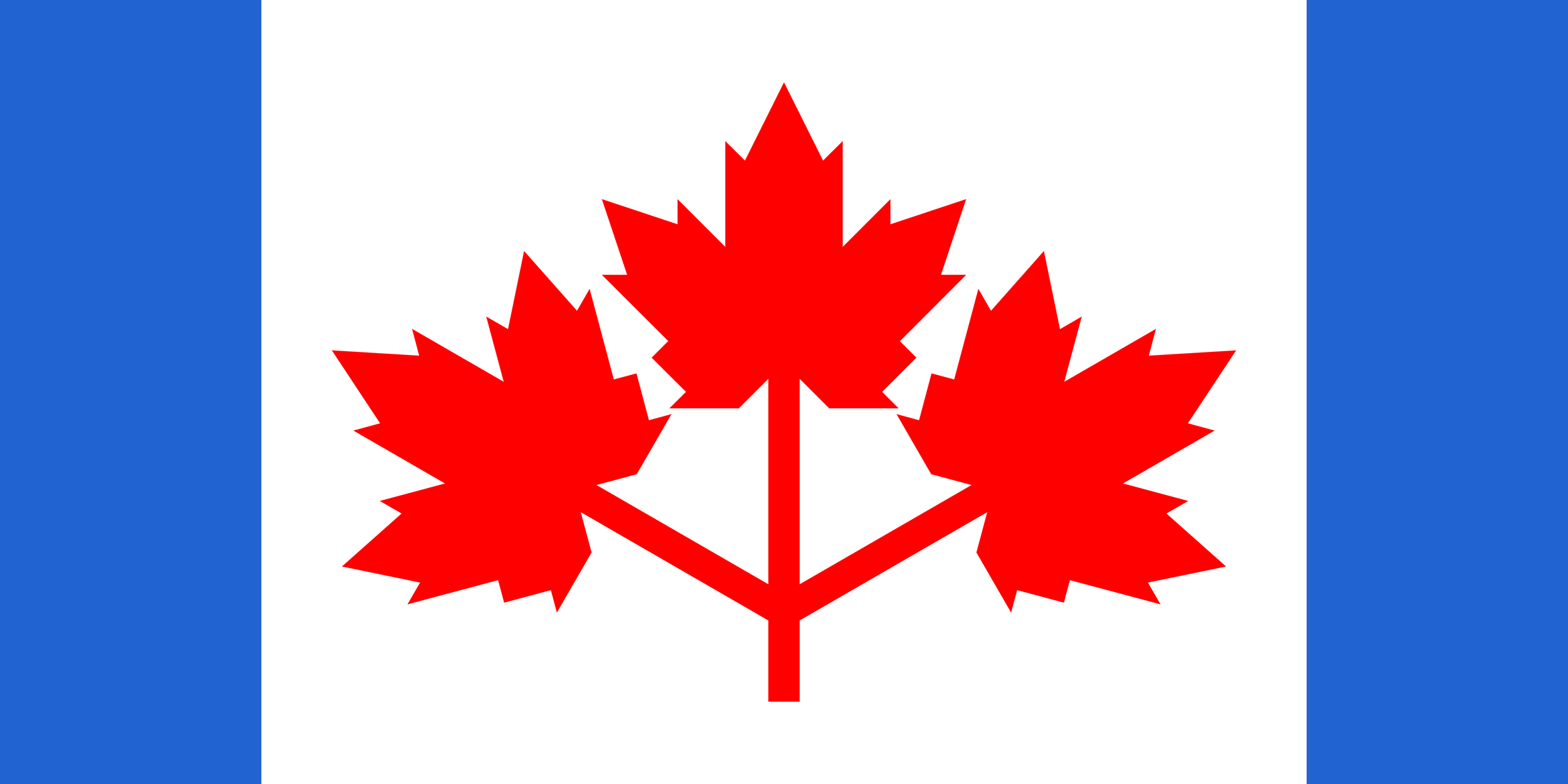
Pearson’s personal preference was a design created by heraldic advisor Alan Beddoe. This design, which quickly became known as the "Pearson Pennant," featured three red maple leaves on a single stem against a white background, flanked by two blue vertical bars. The blue bars symbolized Pearson’s vision of Canada stretching "from sea to sea," mirroring the national motto A Mari usque ad Mare.
When Pearson introduced the concept of a new flag to Parliament in May 1964, he ignited a political firestorm. The leader of the Opposition was John Diefenbaker, the charismatic and fiercely patriotic leader of the Progressive Conservative Party. Diefenbaker, a staunch traditionalist from the Prairies, viewed the removal of British symbols from the flag as an assault on Canada's heritage.
Diefenbaker mobilized his party to launch a massive filibuster in the House of Commons. He argued passionately that the Red Ensign had been consecrated by the blood of Canadian soldiers on the battlefields of Europe. He accused Pearson of catering to Quebec nationalists and dividing the country for political expediency. Diefenbaker demanded that the issue be put to a national referendum, confident that the Canadian public would vote to retain traditional British symbols.
Pearson, operating with a minority government, could not easily force the legislation through Parliament. The debate dragged on through the summer of 1964, paralyzing the legislative agenda. The rhetoric grew increasingly toxic, with politicians and the public trading accusations of disloyalty, anti-British sentiment, and anti-French bigotry.
To break the deadlock, Pearson made a strategic gamble in September 1964. He accepted a proposal to refer the matter to a special, multi-party parliamentary committee. The committee was tasked with studying the issue and selecting a final design within six weeks.
The Special Committee on a National Flag for Canada consisted of 15 Members of Parliament: seven Liberals, five Progressive Conservatives, one New Democrat, one Social Credit MP, and one Créditiste. It was chaired by Herman Batten, a Liberal MP from Newfoundland.
Over the course of six weeks, the committee held 35 meetings, reviewed thousands of public suggestions, and consulted with heraldic experts, historians, and artists. The public response was overwhelming; Canadians submitted over 5,900 designs, many featuring variations of beaver pelts, hockey sticks, northern lights, and maple leaves.
Through rigorous elimination, the committee narrowed the choices down to two primary contenders:
The "Pearson Pennant" (three maple leaves with blue borders).
A design proposed by George Stanley, the Dean of Arts at the Royal Military College of Canada (RMC) in Kingston, Ontario.
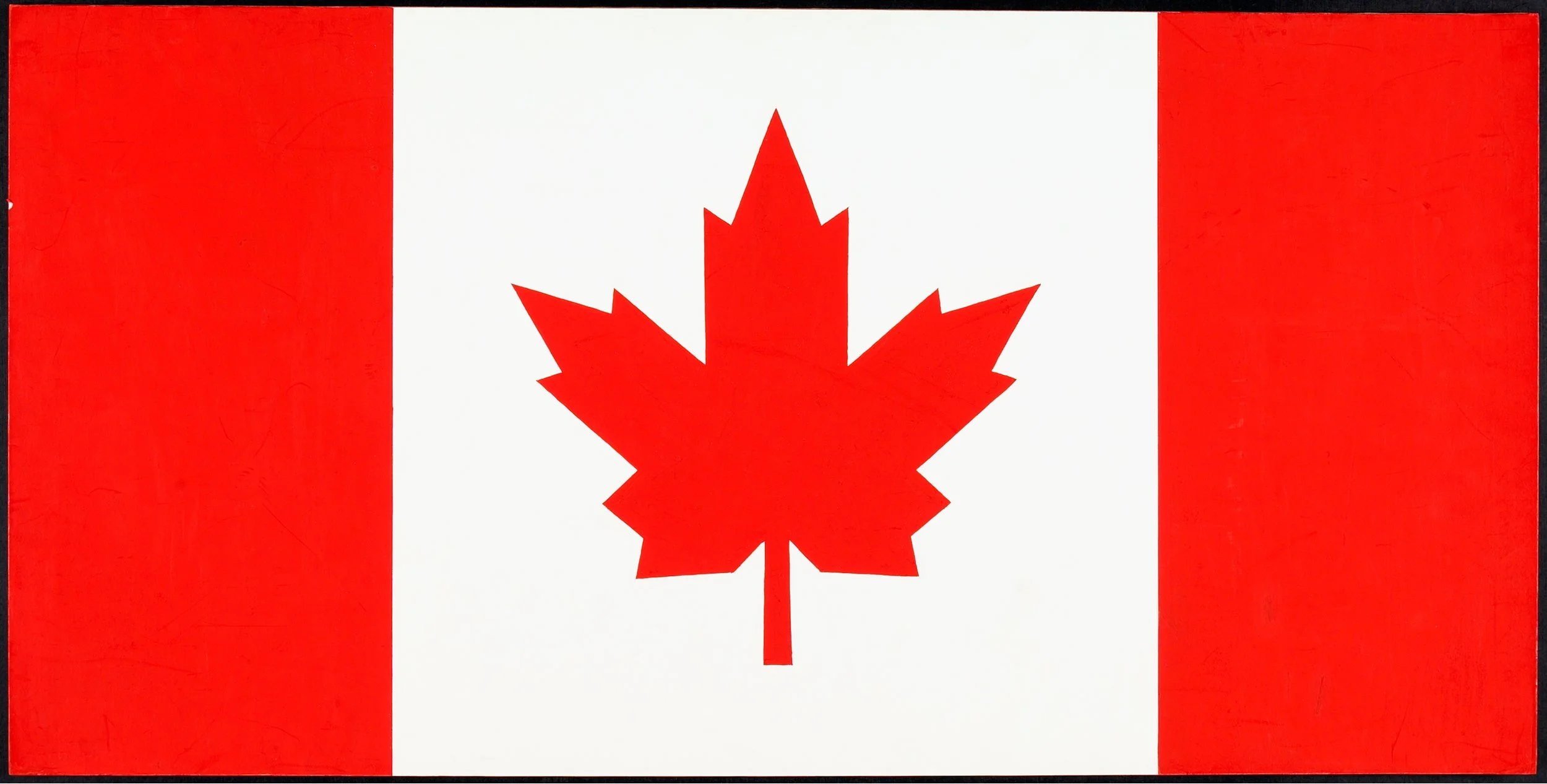
Stanley’s design was inspired by the RMC flag. It featured a single, stylized red maple leaf in the center of a white square, flanked by two solid red borders. Stanley argued that a single leaf was cleaner, more recognizable from a distance, and avoiding the complexity of multiple leaves. Furthermore, he emphasized that red and white were Canada’s official national colors, as proclaimed by King George V in the 1921 Royal Arms of Canada.
The political maneuvering within the committee reached its climax on October 22, 1964. The Progressive Conservative members, operating under the assumption that the Liberal members would vote exclusively for the "Pearson Pennant," decided to vote for Stanley’s single-leaf design. They believed that by backing the Stanley design, they would split the vote or force a stalemate, thereby killing Pearson's preferred option and keeping the Red Ensign alive.
However, this strategy backfired spectacularly. The Liberal members, recognizing the strength, simplicity, and unifying potential of Stanley’s design, switched their votes to support it. The New Democrat and Social Credit members followed suit. To the shock of the Conservative strategists, the committee voted unanimously—14 to 0, with the chairman abstaining—in favor of George Stanley’s red-and-white, single-leaf design.
Despite the committee's decisive recommendation, the political battle was far from over. When the design returned to the House of Commons, Diefenbaker and his loyalists resumed their filibuster, determined to block the adoption of the "Stanley Flag." The debate consumed another six weeks of parliamentary time, with passions flaring late into the night.
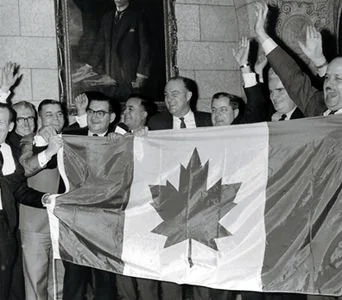
Members of Parliament with new Canadian flag during the flag debate, Ottawa, 1964.
(courtesy Library and Archives Canada/PA-142624)
By December, the country was suffering from debate fatigue. The prolonged bickering had exhausted both the public and the politicians. Realizing that the gridlock had to end, Léon Balcer, a prominent Progressive Conservative MP from Quebec, broke ranks with Diefenbaker. Balcer appealed to the government to invoke closure—a parliamentary procedure that cuts off debate and forces a vote.
Pearson seized the opportunity. On the night of December 14, 1964, amid high tension and an emotionally charged atmosphere, the vote was called. At 2:15 AM on December 15, the House of Commons voted 163 to 78 to adopt the Maple Leaf as Canada’s official national flag. The Senate passed the bill visual days later.
The transition became official when Queen Elizabeth II signed the Royal Proclamation on January 28, 1965. On February 15, 1965, during a formal ceremony on Parliament Hill in Ottawa, the Canadian Red Ensign was lowered for the last time, and the new National Flag of Canada was raised toward the winter sky.
In a speech that captured the spirit of reconciliation, Maurice Bourget, the Speaker of the Senate, declared to the assembled crowd: "The flag is the symbol of the nation's unity, for it, beyond any doubt, represents all the citizens of Canada without distinction of race, language, belief, or opinion.
The Great Canadian Flag Debate was a transformative event that reflected a fundamental evolution in Canadian society. Prior to 1965, mainstream Canadian identity was largely bifurcated. English Canada viewed itself as an extension of the British cultural world, while French Canada maintained a distinct, protective cultural identity rooted in its historical survival.
The adoption of the Maple Leaf helped dismantle this colonial paradigm. By choosing a flag devoid of explicit British or French symbols, Canada embraced a neutral, universal emblem that could belong equally to all citizens. The maple leaf itself was a deeply indigenous symbol, utilized by Indigenous peoples for centuries and adopted by early European settlers. It belonged to the Canadian landscape rather than a specific European empire.
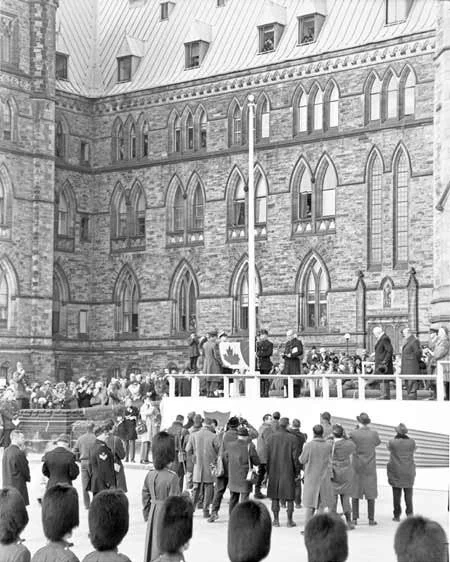
The red-and-white, maple leaf flag is raised for the first time on Parliament Hill, February 15, 1965.
Source: The Gazette, Montreal / Library and Archives Canada / PA-117488
This neutrality proved critical in the decades that followed. As Canada opened its doors to unprecedented waves of immigration from Asia, Africa, Europe, and the Caribbean, the Maple Leaf became an inclusive symbol of a new, multicultural nationality. New Canadians did not have to adopt the historical baggage of the British Crown or the French Fleur-de-lis; they could find a home under an emblem that represented the land and the shared values of freedom, democracy, and human rights.
Furthermore, the flag debate served as a vital precursor to other major institutional modernizations in Canada. It paved the way for the adoption of the Official Languages Act in 1969, which established English and French as equal co-official languages, and the repatriation of the Constitution in 1982, which included the creation of the Canadian Charter of Rights and Freedoms. These milestones collectively completed Canada's journey toward full, sovereign nationhood.
The Great Canadian Flag Debate of 1964 was far more than a dispute over fabric and color. It was a profound domestic crucible through which Canada modernised its identity. While the political battle was characterized by bitter divisions, partisan warfare, and deep-seated fears of losing connection to the past, the outcome was an enduring triumph of national imagination.
The Maple Leaf flag successfully achieved what Lester B. Pearson had envisioned: it gave Canada a distinct visual voice on the global stage and provided an inclusive symbol of unity at home. Today, the flag is recognized worldwide as a emblem of peace, diversity, and progressive values. The rancor of the 1964 debate has largely faded into history, replaced by a deep national pride in a flag that truly represents Canada—sovereign, independent, and looking confidently toward the future.
Recently Posted

Categories
- Alberta 27
- Armed Forces 40
- British Columbia 26
- Canada 327
- Cities 157
- County / Municipality / Regional District / Township 8
- General Information 2
- Government 18
- Historical 4
- Indigenous 41
- International Flags 58
- International Organizations 5
- Manitoba 18
- Miscellaneous 4
- New Brunswick 9
- Newfoundland 12
- Northwest Territories 7
- Nova Scotia 14
- Nunavut 6
- Ontario 41
- Police 1
- Prince Edward Island 5
- Quebec 74
- Royalty 16
- Saskatchewan 15
- Schools 13
- Sports 27
- Yukon 5