The flag of Tsuu T'ina Nation
The flag of the Tsuut’ina Nation is a profound visual testament to a complex history of sovereignty, treaty relationships, and cultural endurance. As one of the most distinctive Indigenous banners in North America, it utilizes the structure of a British Red Ensign while centering a rich, symbolic crest that details the Nation’s specific identity. To look upon this flag is to see a narrative of the "People of the Earth"—the literal translation of Tsuut’ina—and their journey from their Dene roots in the north to their current role as a powerful, self-governing nation bordering the city of Calgary, Alberta.
The historical foundation of the Tsuut’ina Nation is essential to understanding the juxtaposition of symbols on the flag. Unlike the surrounding Blackfoot Confederacy, the Tsuut’ina are of Athapaskan (Dene) descent. According to oral tradition, they migrated southward from the sub-Arctic centuries ago, eventually settling in the foothills of the Rocky Mountains. This northern heritage is a point of immense pride, distinguishing them linguistically and culturally within the Treaty 7 region. This history of migration and adaptation is captured in the flag’s central crest, which serves as a heraldic map of the Nation’s soul.
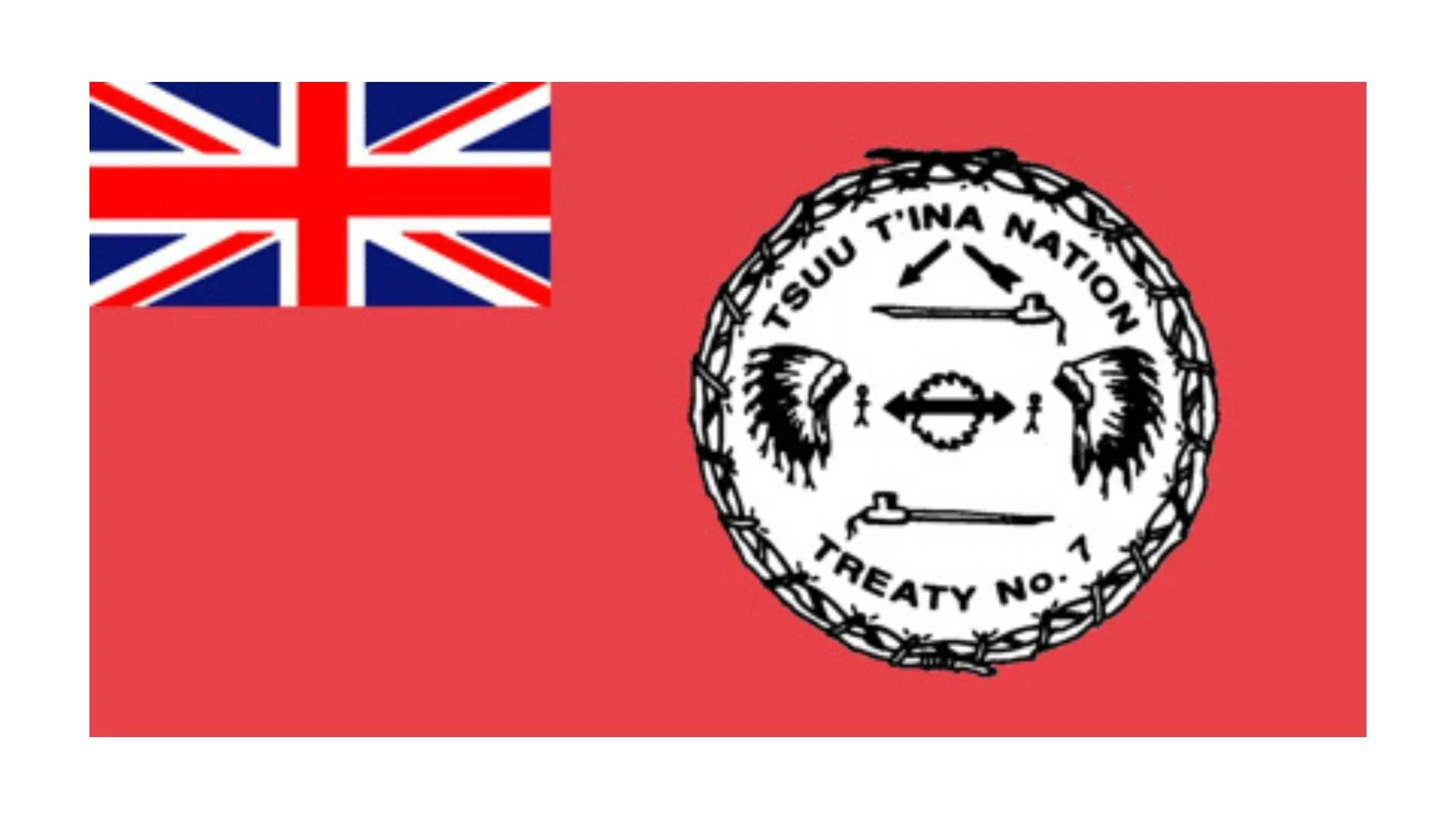
The most striking aspect of the flag is its use of the Red Ensign as a base. Featuring a solid red field with the Union Jack in the canton, the design initially appears to mirror the old Canadian national flag. However, for the Tsuut’ina, this is not a symbol of colonial submission, but rather a bold declaration of a nation-to-nation relationship. The presence of the Union Jack represents the British Crown, with whom the Tsuut’ina signed Treaty 7 in 1877. By retaining these elements, the flag serves as a permanent, visual reminder of the Crown’s ongoing obligations to the Tsuut’ina people. It asserts that they are a sovereign entity that entered into a specific legal partnership with the Monarchy, rather than a subject population.
At the center of the flag sits the Tsuut’ina Nation crest, a masterpiece of symbolic storytelling encased within a circular frame of barbed wire. This frame is a stark and somber element, representing the historical confinement of the people on reserves and the "fencing in" of their traditional territories. Yet, within this restrictive border, the culture is shown to be thriving and complete. The crest is divided into several thematic layers, beginning with the peace pipes positioned horizontally across the circle. These long-stemmed pipes represent the sanctity of the treaty process and the commitment to peace, suggesting that the treaty itself is a living, breathing spiritual contract.
The interior of the crest features two profiles of leaders wearing traditional eagle-feather headdresses, representing the elders and the historical leadership who had the foresight to protect their people's future through negotiation. At the very heart of the crest is a modern addition: a gear-like circle with two arrows pointing outward. This symbolizes the "gears of progress" and the Nation's significant economic development. It reflects the Tsuut’ina’s transition from a nomadic society to a modern entrepreneurial force that manages massive commercial developments. Above this, a broken arrow serves as a universal symbol of the cessation of war, reinforcing the message that the Nation chooses the path of peaceful cooperation while remaining firm in its rights.
The typography on the crest provides the final layer of context. The words "TSUU T’INA NATION" are displayed across the top, utilizing the phonetic spelling that honors their Dene language. Across the bottom, the words "TREATY NO. 7" act as a foundational anchor. This explicit mention of the treaty is a political statement; it reminds every viewer that the Tsuut’ina’s rights to their land and their self-determination are backed by international law and historical precedent. It transforms the flag from a decorative banner into a legal and historical document.
In the modern era, the significance of the flag has evolved. Once seen primarily on the Nation’s administrative buildings, it is now a fixture at major events in Calgary and across Alberta. When the flag is raised during land acknowledgment ceremonies or paraded at the Calgary Stampede, it acts as a silent educator, challenging observers to look past the Union Jack and engage with the Indigenous story at its center. For the members of the Tsuut’ina Nation, the flag is a source of immense pride, representing the "No Quit" attitude that allowed them to survive the harsh prairies and successfully navigate the legal complexities of the 20th century.
In conclusion, the flag of the Tsuut’ina Nation is one of the most complex and meaningful emblems in the Canadian landscape. By daringly combining the symbols of the British Crown with the barbed wire of the reserve system and the sacred pipes of their culture, the Tsuut’ina have created a banner that is both a protest and a celebration. It honors their Dene roots, acknowledges their treaty obligations, and projects a confident vision of their economic future. It remains a steadfast sentinel of their sovereignty, waving as a permanent reminder that the Tsuut’ina people are, and always have been, the masters of their own destiny.
Recently Posted

Categories
- Alberta 30
- Armed Forces 41
- British Columbia 27
- Canada 345
- Cities 164
- County / Municipality / Regional District / Township 8
- General Information 3
- Government 18
- Historical 4
- Indigenous 46
- International Flags 60
- International Organizations 5
- Manitoba 19
- Miscellaneous 4
- New Brunswick 10
- Newfoundland 12
- Northwest Territories 7
- Nova Scotia 15
- Nunavut 6
- Ontario 44
- Police 1
- Prince Edward Island 5
- Quebec 79
- Royalty 17
- Saskatchewan 17
- Schools 14
- Sports 29
- Yukon 5